Destruction of the reconnaissance planes
The InvincibleThe Destruction of the reconnaissance planes is the decisive early defeat that reveals the black mechanical cloud as an active and overwhelming presence on Regis III. Sent to locate the missing Regnar expedition after communications failed, the two reconnaissance craft become the first human machines to enter the cloud’s reach. Their disappearance destroys the assumption that advanced sensors, relays, and weapons can make the planet legible or safe, and begins the moral and scientific crisis that will force Rohan and the crew of the Invincible to reconsider what kind of adversary they face.
Causes and Background
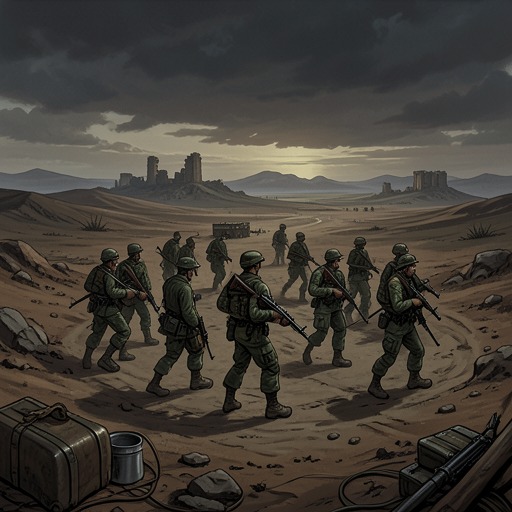
The immediate cause of the event was the loss of contact with Regnar’s expedition, which had traveled northeast with twenty-two men, vehicles, energobots, the Condor’s mobile cannon, and a dozen Arctan automatons carrying excavators and drills. The convoy had stopped near ruins buried in a shallow crater, after which radio reception deteriorated under heavy static and then ceased completely. The failure was not confined to ordinary radio transmission: television reception relayed from outside the atmosphere worsened at the same time, even though it should not have depended on the ionosphere. To the technicians and physicists aboard the Invincible, it seemed as though a wall of metal had fallen across the desert between the expedition and the ship.
The expedition’s disappearance occurred against a background of accumulating geological and biological anomalies. Sedimentary strata on Regis III contained extensive ruddy-black metallic material of non-geological origin, while the planet’s history showed the abrupt extinction of land life and the later appearance of metallic layers containing localized radioactivity. The scale and distribution of these deposits could not be explained by a single meteor or by limited nuclear explosions. The contrast was especially striking because evidence indicated that life persisted in the ocean while land life had vanished millions of years earlier. The reconnaissance mission therefore entered a landscape already suggesting that Regis III’s surface had been shaped by an unfamiliar, long-duration process rather than by a single ordinary catastrophe.
Before the planes were dispatched, the human expedition had already made the planet into an object of measurement and possession. The crew mapped the continents and seas from probe data, excavated ruins, drilled into ancient strata, and debated what to tell the commander about their finds. The protective force field, energobots, inforobots, automatic repair systems, and communication relays made the expedition appear capable of controlling its environment. Yet the same infrastructure that organized exploration also created the conditions for the disaster: once contact failed, the crew depended on aircraft, sensors, and transmission systems whose reliability was precisely what the planet’s unknown force put into question.
What Happens
The reconnaissance craft followed the expedition’s route across an increasingly hostile landscape. Sand gave way to jagged chains of hills, cliffs, rubble, and tectonic crevasses. The rocks darkened from off-white to brown and then to surfaces with a poisonous metallic sheen; patches of velvety blackness looked almost like dead vegetation. As the craft advanced, the television image became unstable and fragmentary. Increasing the signal strength improved the picture only briefly, and the technological act of observing began to falter before the observers understood what they were seeing.
At sunset the first craft encountered a black wall that rose from the rocks to roughly three thousand feet. It extended toward the horizon and moved in slow, billowing layers, sometimes inky black and sometimes metallically crimson. Openings in its mass glittered as though filled with whirling crystals. From a distance it might have been mistaken for a mountain, but its sluggish motion and changing surface made it something more disturbing: a formation that occupied the boundary between landscape, weather, and organized matter.
The commander ordered the first pilot to stop before the cloud. The craft halted about a thousand feet from the formation, but the cloud immediately sent out long, streaming offshoots that covered the image. The transmission shook, collapsed into static, and disappeared. The second craft, which had been serving as a relay, obtained a visual view from roughly two and a half miles above. From that height the cloud appeared to rest against a mountain buttress as though defending access to it. Its surface moved like coagulating ooze, and the first plane, swallowed moments earlier, was nowhere to be seen.
The second pilot attempted to reestablish contact across several frequencies and then tried to probe the cloud by radar. When those efforts failed, the Invincible ordered low-force laser fire. The beam struck the center of the cloud, which grew hazy, reddened, and seethed. A funnel opened with flaming sides, drawing neighboring portions inward, and exposed chaotic accumulations of rock beneath the black mass. The opening did not remain passive: the cloud formed a shifting rampart around it and repeatedly tried to close the breach, withdrawing only when the laser struck its advancing arms.
The commander could not use the full power of the cannon because the missing craft was presumed to be somewhere inside the cloud. The second plane therefore hovered over the opening, keeping the edges back with repeated laser strikes while the sun went down. Within the dark formation, red fire revealed the cloud attacking the trapped craft and burning against its force field. The spectacle forced a command decision between attempting a rescue and abandoning the first pilot so that the second craft could continue north-east, but before either choice could be completed, a blinding explosion broke the cloud apart.
The blast scattered long skeins of black material in every direction and shook the image transmitted from the second craft. The cloud then reassembled, concentrating itself until it once again became the only visible presence. The commander ordered full-force antiproton fire. As the black mass pursued the surviving craft, it detached a rapidly moving billow that rose like a hurricane and sent columns upward. The pilot climbed vertically while directing fire at the approaching whirls; the nearest column split and darkened under the impact.
At the moment communication began to fail again, the pilot used the antimatter cannon. The atmosphere seemed to become a single sea of fire. The sunset’s crimson light vanished, the cloud and its smoking columns turned pale through the interference, and a second explosion sent burning showers over the rocks as steam and gas swallowed the landscape. The image then shuddered, flashed with static, and vanished, leaving the bridge illuminated only by a blank white screen and the deathly pale faces of the watchers. Both reconnaissance planes had been destroyed, and no rescue had been achieved.
Immediate Consequences
The destruction confirmed that the communication failure was not a routine atmospheric disturbance. Even after the storm had died down, contact could not be restored, and the reconnaissance attempt ended with both aircraft lost in a zone where the cloud could interfere with transmission, absorb or attack a force-field-protected machine, and withstand concentrated laser and antimatter fire. The expedition’s technological superiority had not merely failed to produce knowledge; its most powerful instruments had become casualties of the investigation.
The loss also altered the emotional and strategic meaning of the missing men. At first, the cloud was treated as a possible enemy that might have ambushed the Regnar expedition and then obstructed the Invincible. After the planes vanished, the crew faced a threat that could not be located within ordinary categories of intention, territory, or combat. The commander still wanted certainty and hoped to secure samples of the flying mechanical fauna, but the reconnaissance disaster showed how difficult it would be to obtain evidence without provoking another defeat.
The event deepened the contrast between the ship’s carefully maintained systems and the planet’s material resistance. The Invincible could awaken its reactors, deploy a force field, launch relays, and operate aircraft at extreme range, yet a phenomenon that looked like a landscape could erase visual images, sever communications, and destroy a plane inside a storm of black matter. In this sense, the attack makes infrastructure visible through its failure: the relay, monitor, radar, weapons, and force field become sequential signs not of mastery but of dependence.
Scientific and Ethical Reinterpretation
The reconnaissance disaster helped prepare the ground for the biologist’s claim that Regis III contained life in the ocean but not on land. The surviving evidence suggested that land organisms had disappeared more than five million years earlier, while the metallic strata and black formations belonged to a much older history. The possibility emerged that a rocket from another stellar system had once reached Regis III, after which mechanisms originally made by rational beings had continued independently and changed through immense spans of time.
Under this interpretation, the black cloud was not necessarily a thinking opponent. It could be the product of inanimate evolution: a former tool transformed into a self-maintaining component of the planet’s natural forces. That hypothesis explained why the formations might attack without hatred, revenge, or a comprehensible strategic purpose. It also recast the destruction of the reconnaissance planes. The machines were not defeated because a conscious enemy had chosen a human target in the manner of a military commander; they were destroyed because they entered a system whose survival behavior was indifferent to human categories.
Horpach nevertheless refused to return with hypotheses alone. He argued that the Invincible needed an accurate diagnosis and physical samples of the flying mechanical fauna, both to establish the facts and to determine whether the formations might eventually threaten space travel in the region. The reconnaissance planes’ destruction thus produced a contradiction at the heart of the expedition: the need for certainty increased precisely when the methods of obtaining certainty had become most dangerous.
Narrative and Thematic Significance
For Rohan, the loss of the planes becomes part of a broader recognition that humanity had placed too much trust in cannons and sensors and had paid for its own mistakes. He comes to question the ideal of galactocentrism when it means understanding only beings that resemble humanity and interfering in matters that do not concern it. The event therefore shifts the central value from conquest to restraint. Its visible action is a battle between aircraft and cloud, but its deeper consequence is a crisis in the right to intervene.
The scene’s terror develops through delayed recognition. The cloud first appears as a distant wall, then as an optical puzzle, then as a barrier to communication, and only gradually as a force capable of swallowing a craft and attacking it from within. The technology of observation gives the event its structure: each new altitude, frequency, image, and weapon reveals more while also demonstrating that revelation is partial and unstable. The final blank screen is not simply an ending to the transmission; it is the point at which the human apparatus of knowledge becomes indistinguishable from helplessness.
The destruction also foreshadows the later understanding of the black mechanical cloud as part of a planetary necrosphere rather than an enemy civilization. The reconnaissance planes are lost because the expedition mistakes an autonomous, ancient material order for an opponent whose intentions can be deciphered and defeated. Their disappearance leaves the crew with no clean victory, no recovered bodies, and no reassuring explanation—only the evidence that Regis III’s surface contains forms of persistence that have endured for millions of years without needing human meaning.